No NEWvember: Stop Creating From Scratch and Make Your Existing Content Work Harder
If November usually sneaks up on you with a giant pile of marketing tasks, holiday plans, family commitments, end-of-year loose ends, and a blinking cursor asking, “So…what are we posting today?” then welcome to No NEWvember.
We’ve talked a lot about the author ecosystem and your content repurposing strategies this year. This blog is truly one to print out, make notes on and repurpose (see what I did here?😝) every year.
The idea is simple:
November does not need to be the month you create more content. It can be the month you make the content you already created work harder.
Because here’s the truth…you probably already have more usable content than you think.
Old blog posts.
Podcast episodes.
Newsletter content.
Social posts that performed well.
Live trainings.
Interviews.
Videos.
Book excerpts.
Classes.
Slides.
Reader questions.
FAQs.
You already did the hard part. You created the ideas.
No NEWvember is about taking that existing work and turning it into more visibility, more connection, and more mileage…without creating yourself into a holiday-season puddle.
In other words, we are repurposing our content so we can keep our holidays jolly days. 🎄✨
The One-and-Done Trap
One of the most common mistakes I see authors make is what I call the one-and-done trap.
It looks like this: You spend time creating a piece of content. You research it, write it, edit it, design something to go with it, hit publish…and then share it once. Maybe twice.
Then the next week rolls around, and you sit down to create something brand-new. Again. And again. And again. That cycle is exhausting because every piece starts from zero. The bigger problem is that you’re leaving a lot of value sitting on the table. A strong piece of content contains ideas, examples, quotes, stories, teaching moments, questions, and takeaways that can live far beyond the first publish date.
Publishing should not be the finish line. It should be the starting line.
In Episode 46 of the Authors’ Allies Podcast, I talk about why repurposing is one of the most powerful growth strategies available to indie authors, including the one-and-done trap, the difference between reposting and repurposing, and why extending the life of your content matters.
Repurposing Is Not Reposting
This distinction matters. Reposting is sharing the exact same piece again. Same link.
Same caption. Same image. Same everything. Sometimes that’s perfectly fine. I do it strategically with my podcast and blogs. But repurposing is different.
Repurposing means taking the core idea from something you already created and adapting it into a new format that makes sense for a different platform or audience.
For example, let’s say you wrote a blog post about why the setting of your novel matters. You could turn that one blog into:
A quote graphic with your strongest line
A short Reel where you talk about the idea for 60 seconds
A Facebook post with a quick story from your writing process
An email to readers with a personal intro and a link to the blog
A podcast episode where you go deeper
A carousel sharing three reasons setting matters
A story post asking readers to share their favorite fictional setting
Same core idea but in different formats. That is the magic of repurposing.
You’re not constantly inventing new topics. You’re giving your best ideas more places to live.
Why Repurposing Is Perfect for the Holiday Season
This is exactly why I love the idea of No NEWvember. By November, most of us do not need another giant content challenge. We need breathing room. We need time for family, travel, cooking, shopping, end-of-year planning, naps, Hallmark movies, or whatever makes the season feel like the season. And if you’re an author, you probably also need time to…you know…write.
Repurposing helps because it saves creative energy that you can use for your writing.
Start With One Core Asset
The easiest place to begin is with one strong piece of existing content. Think of it as your core asset. This could be:
A blog post
A podcast episode
A newsletter
A video
A live class
An interview
A reader Q&A
A chapter excerpt
A social post that performed especially well
Choose something with substance. The more fully developed the original piece is, the more material you have to pull from. Then ask yourself:
What are the three to five most shareable moments inside this piece?
Look for:
A great quote
A strong opinion
A helpful tip
A surprising fact
A question your audience often asks
A story or example
A line that made you think, “Yep…that’s the good stuff.”
Those moments become your repurposing seeds.
The Three-Phase Repurposing System
In Episode 47, I broke content repurposing into three phases.
Phase One: Establish the Core Asset
This is your original long-form content.
One of my own examples started as a live class inside the Authors’ Allies RoundTable.
That one class became:
A slide deck
A blog post
An email newsletter
One idea, already doing multiple jobs.
Phase Two: Amplify It Across Platforms
Next, take the strongest pieces of that core asset and distribute them in ways that fit your platforms.
That might include:
Social posts
Story posts
Quote graphics
Short videos
Reels
YouTube Shorts
TikToks
Newsletter snippets
The goal is not to paste the same thing everywhere.
The goal is to adapt the idea so it fits naturally where you’re sharing it.
Phase Three: Extend the Lifecycle
This is the part most people skip. Ask: What else could this become?
Could the blog become a podcast?
Could the podcast become five graphics?
Could the class become a checklist?
Could the interview become an email series?
Could a popular social post become a longer blog?
Every new asset creates another doorway into your content.
Episode 47 takes you behind the scenes of how this kind of repurposing system actually works in practice.
The Content Loop: Why Your Content Should Not Have a Finish Line
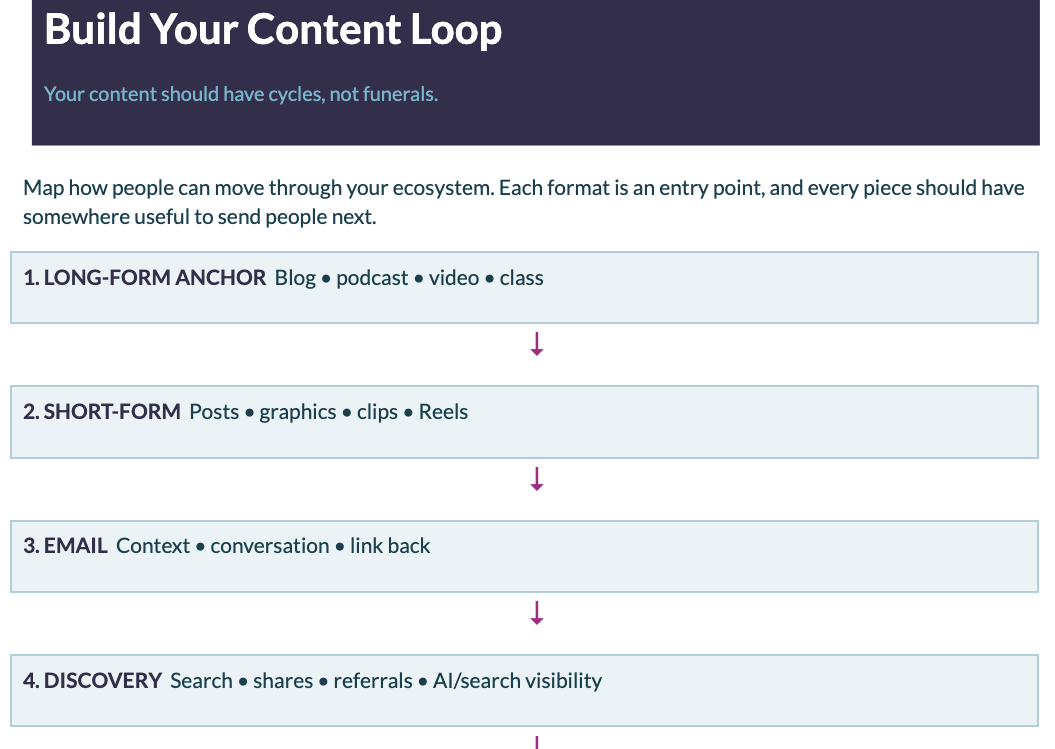
By Episode 48, this whole idea had evolved into what I call the Content Loop.
Instead of thinking of content as: Create → Publish → Done Think of it as:
Long-form content → Short-form content → Email → Search and discovery → Back into your ecosystem
Your blog can lead people to your podcast. Your podcast can lead people to your email list. Your email can send people back to your blog. Your social posts can introduce someone to the podcast. A Google search or AI recommendation can bring a completely new person into the loop.
Everything supports everything else. That is the goal. Your content stops being a pile of isolated posts and starts becoming an ecosystem. And that is where your marketing gets a whole lot easier.
Turn One Piece Into Five Assets
If all of this sounds lovely but also makes you want to hide under a blanket, start here.
Choose one existing piece of content and turn it into five simple assets.
1. Create a Quote Graphic
Pull one line that is especially strong, helpful, funny, insightful, or memorable.
Put it on a branded graphic.
Done.
2. Record a Short Video
Talk about the main idea for 30 to 60 seconds.
No giant production required.
You, your phone, one idea.
3. Write an Email Excerpt
Pull one useful point from the original content and add a little personal context.
Then link people back to the full piece.
4. Create a Social Post
Summarize the core idea in a few sentences.
Ask a question, share a takeaway, or encourage people to read or listen to the full version.
5. Create a Story Post
Keep it casual.
Something as simple as:
“I shared something this week that I think more authors need to hear…”
Then link to the original content. That’s it. One source. Five assets. And you did not need five new ideas.
Schedule It…and Walk Away
Now comes the part that can make your November feel dramatically lighter.
Schedule it. Do not post all five assets on the same day. Spread them across days or even weeks.Let the same core idea show up at different times, in different formats. And here’s an extra step that makes this even more powerful:
Schedule a repost or reshare 30 to 60 days later.
Why? Because most of your audience did not see the content the first time. They were busy. The algorithm did not show it to them. They were not following you yet. They saw it and meant to come back…… etc. Repurposing and resurfacing good content is not annoying. It is smart marketing.
Your No NEWvember Challenge
Here is your assignment for November.
Do not start by asking what new content you need.
Instead:
Pick one piece of content you already created.
Identify three to five strong moments inside it.
Turn those moments into new formats.
Schedule them across November and December.
Build in at least one future reshare.
Then do it again with another piece.
You may be surprised by how much content is already sitting in your archive waiting for a second life.
And that is really the heart of No NEWvember. You do not need to create more just because the calendar says you should be posting. You need to use what you already have more intentionally.
The Big Shift
If there is one thing I want you to take away from No NEWvember, it is this:
Stop asking, “What should I post today?”
Start asking:
“How can this one piece of content work harder for me?”
That is the question that helps you stop chasing content and start building a system.
More consistency. More time. More jolly days. 🎄✨
Now, use the workbook and build it so you can relax!: Payhip
Frequently Asked Questions
What is No NEWvember?
No NEWvember is a challenge to make your existing content work harder instead of creating new content from scratch. Rather than starting a blinking-cursor search for fresh topics during a busy month, you adapt past blog posts, podcasts, newsletters, and videos into new formats and schedule them in advance.
What is the difference between repurposing and reposting?
Reposting shares the exact same piece again, with the same link, caption, and image. Repurposing takes the core idea of something you've already created and adapts it into a new format for a different platform or audience, such as turning a blog post into a quote graphic, Reel, email, or carousel.
Why should authors repurpose content instead of creating new content?
Repurposing saves time and creative energy, which is especially valuable during the holidays and for authors who also need to write. A strong piece of content holds ideas, quotes, stories, and takeaways that can live well beyond the first publish date, so you get more visibility from work you've already done.
What is the one-and-done trap?
The one-and-done trap is publishing a piece of content, sharing it once or twice, then starting from scratch on something new the following week. The cycle is exhausting because every piece begins at zero, and it leaves value unused. Publishing should be the starting line, not the finish line.
What types of content can I repurpose?
Almost anything you've already created: old blog posts, podcast episodes, newsletter content, high-performing social posts, live trainings, interviews, videos, book excerpts, classes, slides, reader questions, and FAQs. Choose a substantial piece as your "core asset," since a more developed original gives you more material to pull from.
What is the three-phase repurposing system?
Phase one is establishing a core asset, your original long-form content. Phase two is amplifying it across platforms with social posts, quote graphics, short videos, and newsletter snippets. Phase three is extending the lifecycle by asking what else it could become, such as a blog turned into a podcast or a class turned into a checklist.
What is the Content Loop?
The Content Loop treats content as an ecosystem instead of a one-time "create, publish, done" process. Long-form content feeds short-form content, which feeds email, search, and discovery, which brings people back into your ecosystem. Your blog, podcast, email list, and social posts each point readers to the others.
How do I turn one piece of content into five assets?
Start with one existing piece and create:
A quote graphic
A 30 to 60 second video
An email excerpt with personal context
A short social post
A casual story post that links back to the original
Spread them out rather than posting them all on the same day.
How often should I reshare repurposed content?
Schedule a reshare 30 to 60 days after the original post. Most of your audience didn't see it the first time because they were busy, weren't following you yet, or the algorithm didn't show it to them. Resurfacing good content is smart marketing, not annoying.
If you are looking to join an amazing community of authors and create your marketing strategies and promotions piece by piece while writing your book [or living your life], Check out our FREE group on Skool. Authors' Allies RoundTable. We'd love to meet you.